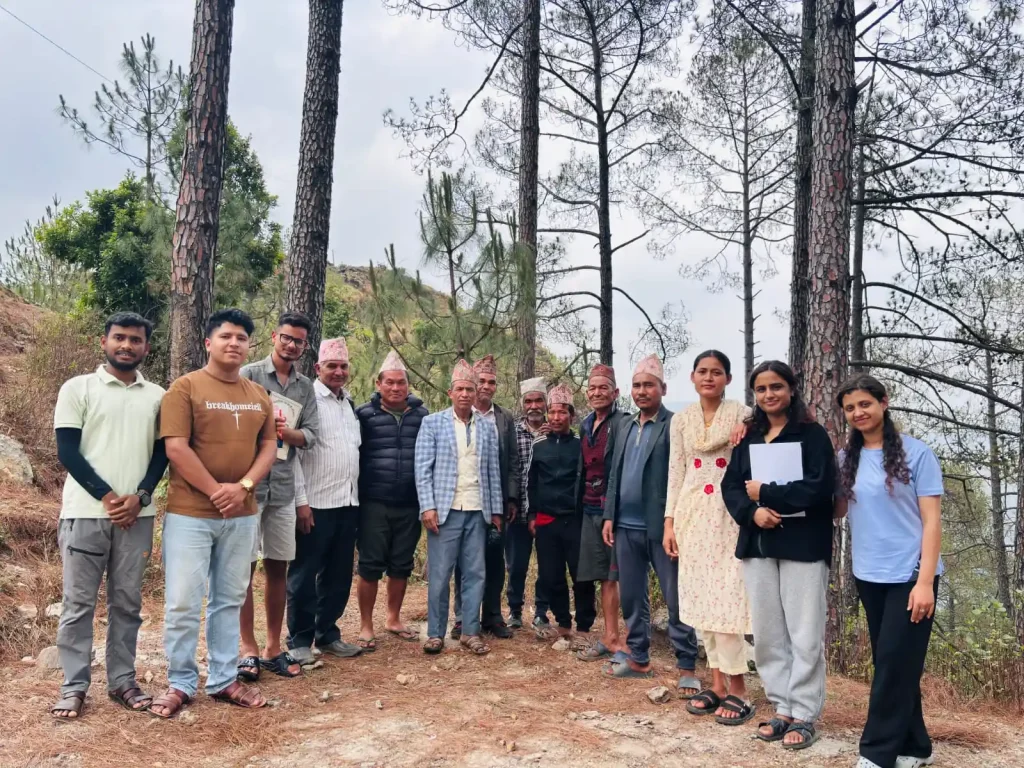
Project Overview: 5-Year Community Forest Operational Plan
Forest Name: Hile Community Forest (श्री हिले सामुदायिक वन)
Location: Kapurkot-2, Garpa, Salyan District, Nepal
Total Area: 191.09 Hectares
Plan Period: FY 2082/083 to FY 2087/088 (5 Years)
Role & Team Leadership
Position: Technical Team Lead
Team Composition: 6 members altogether
Key Responsibility: Overseeing the entire technical process of forest inventory, community consultations, data analysis, and compilation of the operational plan in strict compliance with the government guidelines of Nepal.
Methodology & Technical Approach
The operational plan was formulated following the step-by-step participatory process prescribed by the Government of Nepal for community forestry. The fieldwork and technical assessments involved:
Boundary Mapping: Conducted precise boundary delineation and verification using GPS surveying to update the forest map and clarify four-villa (char-killa) coordinates.
Forest Inventory & Sample Plot Establishment: Implemented a stratified systematic sampling method with a 0.5% sampling intensity. Established nested sample plots via fish netting for different growth stages:
- 20m × 25m plots for mature trees.
- 10m × 10m plots for poles.
- 5m × 5m plots for saplings.
- 2m × 5m plots for seedlings.
Resource and Water Hole Survey: Documented biodiversity, non-timber forest products (NTFPs), wildlife habitats, and conducted critical spatial mapping of existing water holes for conservation.
Socio-Economic Assessment: Conducted household surveys among the 59 consumer households to complete well-being rankings (SAMPANNATA STARIKARAN) across categories A, B, C, and D.
Stakeholder Consultations: Facilitated interactive meetings with the Community Forest User Committee (CFUC) and organized local gatherings (Tole Bhela) to understand community demands, resource needs, and equity-based distribution priorities.
Prioritizing Sustainable Resin Extraction
Because the Hile Community Forest is prominently characterized by Pinus roxburghii (Khote Salla) dominance, the forest user group derives the majority of its institutional income from pine resin extraction.
- Technical Provisions: Integrated specific, sustainable resin tapping guidelines utilizing the Rill Method.
- Sustainability Measures: Set strict limits ensuring only trees with a diameter at breast height (DBH) exceeding are selected for tapping, while leaving a minimum of 5 mother trees per hectare untouched to safeguard natual regeneration and forest health.
Data Analysis & Deliverables
Data Processing
Collected raw plot data from the fields, calculated the growing stock, and performed rigorous data analysis using MS Excel. Formulae like the standard volume equation were utilized to compute stem volumes and baseline metrics for the operational plan.
Annual Allowable Harvest (AAH)
Based on the inventory findings showing a growing stock of , the annual allowable harvest for timber was calculated safely at 40% of the annual increment (1265.98 cu.ft.) to prevent over-exploitation.
Final Output
Authored and compiled the comprehensive 5-Year Operational Plan and Constitution Report, successfully incorporating annual forest silvicultural schedules, fire line maintenance, community development funds, and climate adaptation programs.